
Favorite Workout: Aerobic Threshold Explained
by GRP Runner Stephen Kerr

Photo by Phil Belena
Aerobic threshold workouts are my favorite workouts for easily stackable benefits like increased aerobic capacity and improved economy, as well as increased mitochondria and capillaries, without necessitating multiple days of recovery like many higher intensity workouts do.
Your aerobic threshold (AeT) is defined by a shift in your body’s energy source from fat to glycogen/glucose. If you are below this threshold, you needn’t be worried about gradual lactate buildup, and your effort will have a feeling of sustainability to it. Deeper, rhythmic breathing should be achievable. Accelerating beyond AeT, you will perceive less rhythm and depth, and will have a slightly more ‘jostled’ feeling.
The difference between AeT and lactate threshold
Lactate threshold (LT) is the point at which your body is producing lactate faster than its ability to clear it, thereby leading to decreased efficiency and increased effort. The two thresholds indicate different (but related) physiological changes. LT relates to lactate production as pace/effort changes and AeT indicates your body’s substrate utilization as pace/effort changes. The key practical difference is that running at/near AeT means that most every runner is WELL below LT, and does not seek to train the systems that operate there. In other words, by running near AeT, we are not directly seeking to increase our lactate threshold.
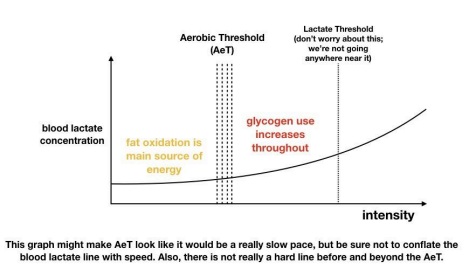
There are many in-depth technical definitions to be found in the literature, each of which might illustrate different qualities of the AeT. The most important thing is to get out and feel it for yourself. This may take some trial and error. I recommend you feel for AeT by approaching from a very easy pace and progressing gradually. Once you arrive near AeT, you can take a moment to internalize the feeling it takes at that effort, and focus on maintaining it.
Your session will conclude when you perceive certain physiological changes despite not consciously modulating your effort. These can include faster breathing, increased heart rate beyond what’s been sustainable for most of the workout (cardiac drift), a less smooth action in your stride, or a reduced capacity for focus. Whatever it is, this is your sign to finish the workout.
For runners, a well trained athlete may be able to stay near AeT for 1-2 hours. This pairs well with a long or mid-long run. Athletes unaccustomed to this training may find they can only stay near AeT for 30 minutes or less. It is worth emphasizing that the duration and pace are secondary to landing yourself in the right zone. Let’s say you want to be impressive and stay at AeT for 2 hours. You can’t just muscle through it. If your body can’t sustain that, there is nothing you can do to change that today. In a month or two or six, you can make progress, but today, you are where you are, so don’t bother to force a certain duration or pace that is beyond the AeT.
The Workout
I implement this workout most frequently in the following way: first, I make sure to warm up very gradually, starting from a shuffle. I allow my pace to increase without increasing effort. This will happen naturally as your heart rate rises and your mechanics calibrate. I know I’m at the right pace for AeT when it would take deliberate effort to increase it. I find there is a distinct feeling of ‘pushing’ that it will require to get to your lactate threshold pace. If you’ve gotten there, you will want to scale back on effort ASAP and try to recalibrate. Once my pace levels off, I continue focusing on staying relaxed, and I know when I’m done when my physiological effort starts to increase without me trying to do so.
It takes practice to become aware of your AeT, and it is highly variable, from day to day and hour to hour, so paying attention to your internal feeling is a must. Good luck, and don’t hesitate to reach out if you have questions.