
Four Types of Focus: Nideffer's Landmark Attentional Model, Applied to Running
by GRP runner Stephen Kerr

Photo by Tom Dils
What if you could improve your performance, increase enjoyment, and enrich your experience simply by shifting your attention?
Well, there might actually be a way to do that. In 1976 psychologist Robert Nideffer, Ph.D, published an article in the Journal of Personality and Social Psychology* detailing a model which divides our types of focus across two dimensions: width and direction. Width expresses how broad or narrow our focus is, while direction stipulates whether that focus is internal (mind and body) or external (environment). These two dimensions leave us with four possible attentional styles, as shown in the figure below.
Broad-external focus allows us a comprehensive picture of our environment: the entire symphony of dynamics happening around us.
Narrow-external focus is characterized by a concentrated flashlight of awareness upon a single object, like watching a stoplight for when it turns green.
Broad-internal focus allows us a comprehensive view of abstract concepts. When we are making decisions that involve numerous dynamic factors such as timing and coordination, we are using broad-internal focus.
Narrow-internal focus is, similarly to narrow-external, a concentrated flashlight of awareness. This time, though, the flashlight focuses on an internal sensation, movement, or thought: the feeling in your foot as you first step on the floor in the morning; balancing a ball on your hand; a single repeated mantra or concept.
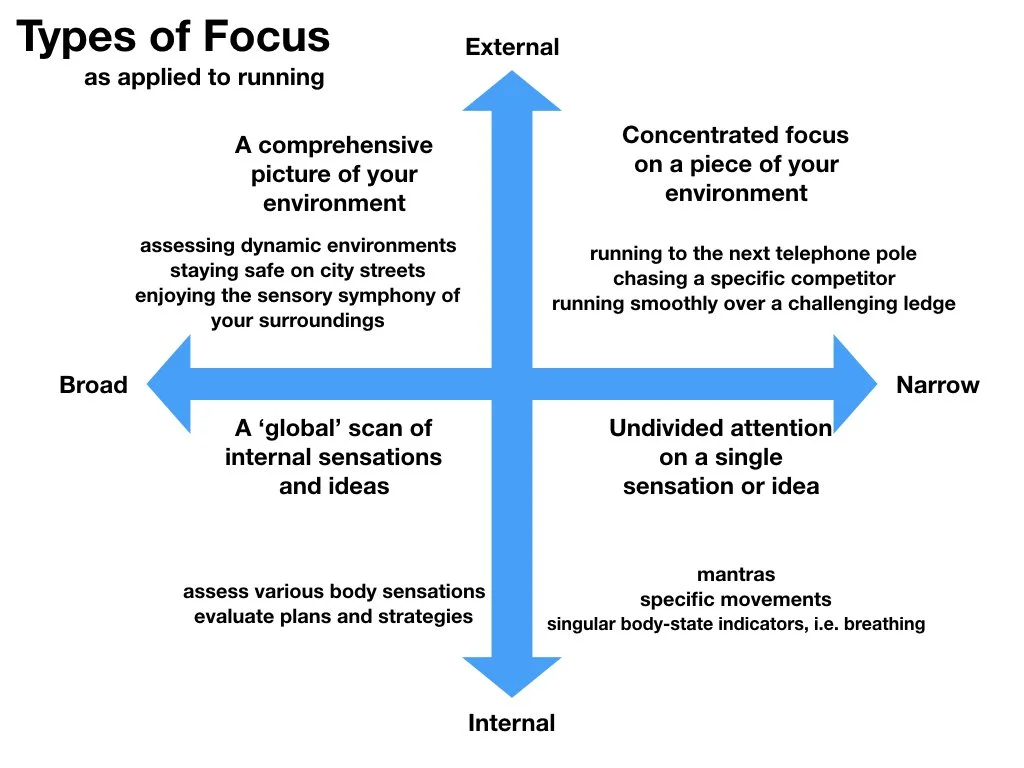
So, how can we use these concepts to help enrich and improve our running?
Here are some examples:
When running in dynamic environments like city streets or winding wooded trails, broad-external focus is essential to keep track of passing cars, pedestrians, and signposts, or tree branches, ledges, and switchbacks. In environments where your path is not so challenging, broad-external focus can allow you to enjoy the colors and sounds around you: light, clouds, and sky, birdsong, the visual interplay of trees as you pass. In a race environment, this kind of focus can help you keep track of (and respond to) the varying pace changes in competitors, or allow you to smoothly tackle technical trails.
You can use narrow-external focus in any instance when deeper concentration might be needed. The object of concentration could be the number on your watch as you try to nail a perfect split, or it could be a single competitor you’re aiming to stay with. This type of focus can be conceptualized as the “execution” state. If you are assessing complex situations with broad-external focus, you are levying a response with the narrow-external. A classic example would be the use of telephone poles as benchmarks for pushing oneself on a run, i.e. “just get to the next telephone pole”.
Broad-internal focus is the mindset where you assess your body and listen to its feedback (pain, fatigue, adrenaline, etc.). This is also where you may evaluate your plans/strategies. With broad-internal focus on, you can become more intimately familiar with the relationships between heart rate, breathing rate, muscular fatigue, stiffness, or any other physical element of running. After internal analysis of these various systems, you may eventually bring your focus to the external in order to act on decisions.
Narrow-internal focus works very similarly to narrow-external, the difference being that the chosen subjects will be mental or physical sensations. If someone tells you to “focus on your breathing”, that is an example of narrow-internal focus. A lot of technique work is based here; internal feeling is an important element of physical memory. Let’s say you are working on improving your form during plank exercises. While external feedback might be useful in the form of visual body cues, internal feedback is what must be truly learned in order to better position oneself. When it comes to running, position and posture can be learned using narrow-internal focus as well.
Another application for narrow-internal focus, as mentioned before, is the use of mantras. These repeated words or short phrases allow us to hone in all our mental concentration on one particular concept, allowing us to better coordinate our body to follow that concept.
To conclude, it is well worth pointing out that the common word in all four categories is, of course, focus. Focus itself is an incredibly useful tool for performing to a higher standard, and enjoying your activity with a higher capacity. With that said, it also takes energy to concentrate one's energy, so remember to allow yourself mental recovery time with some freewheeling, unstructured thinking.
The next time you go for a run, apply the four types of focus, using the above suggestions as a guide. You might discover they allow you to not only increase your capacity for performance, but also to increase your ability to enjoy your runs in brand new ways.
*Vol. 34, No. 3, pgs. 394-404