
Tech Tip: Spice Up Your Erg Marriage
by GRP Row coach S. Hap Whelpley
As the Vermont days start lengthening but the snow banks are yet deepening, it signals that we are past halfway in our winter training, but still in the depths of winter nonetheless. As a result, it is important to stay attentively engaged with how we are training. While the Green Racing Project rowers advance a ton of skills applicable to rowing through cross country skiing, we also need some assurance that we are directly improving at our sport as well. This is not a post about the importance of cross-training (a worthwhile post in its own right), but rather some tips on how to keep advancing your rowing while erging.
In Malcolm Gladwell's book Outliers, he talks about people achieving mastery of a trade or skill in 10,000 hours. This has become known as the 10,000 Hour Rule. Malcolm Gladwell claimed, “It takes ten thousand hours to truly master anything. Time spent leads to experience; experience leads to proficiency; and the more proficient you are the more valuable you’ll be.” The book also makes it clear that these 10,000 hours must be deliberate. You can't just clock in and clock out. You must engage deeply and intensely with the act in order to gain mastery from those hours. While the book points out other traits about mastery, many of the examples tie back into the 10,000 Hour Rule. The examples range from musicians to athletes to computer programmers. None of the examples are rowers.
As a rowing coach, overuse injuries are second nature to me. Sometimes, I assume that it is just a byproduct of being an athlete. However, contact sports have a much higher rate of acute, traumatic injuries, and low-contact sports have a much higher rate of overuse injuries. Here is an article from Michigan State University that discusses this further. Why is this pertinent? A violinist doesn't practice one song for 10,000 hours. A basketball player doesn't shoot free throws only for 10,000 hours. However, a rower only rows for 10,000 hours. Endurance sports by nature require a high volume of repetitive motion. While we have some variation based on conditions, boat class, stroke rate, or discipline (sweep or scull), this is much less variation than a hockey player experiences in the course of a practice or a game. This drives me to two questions: 1) Does it still take 10,000 hours to master something that is more repetitive? 2) How do you keep your practice of a repetitive motion deliberate? The latter question is where we have to put some thought. Especially when we're on the erg!
Change the force application
It is easy to get into a "ho hum" rhythm with our rowing. Just grinding away at a stable stroke rate and split. While you could intentionally bounce around from stroke to stroke, that wouldn't be beneficial for advancement in our sport. Instead, you can change the force application and acceleration profile by adjusting the drag. Although drag factor is not exactly anonymous with changing boat classes, it will change the profile of the resistance and thereby your acceleration. If you try to hit the same split at the same rate at a different damper, it will force your stroke to unfold in a different manner. This change in stimulus can be key to keeping your attention on how you do things.
The common go-to for rowing is to increase resistance. While this can be beneficial and similar to a bungee or drag row in a boat, it can also be beneficial to drop that drag to the bottom. Try to go fast by how quickly you move rather than just how hard you move. Our GRP Ski coach, Pepa Miloucheva, helped me with a few rowers that lacked power. She had an immediate suggestion that they needed to do short intervals with ample rest with the least amount of resistance possible. She wanted to see them quickly turning strokes over to generate power by speed more than force. This turned into rowers doing intervals on either a Concept2 Dynamic Erg or a Concept2 Static Erg on sliders with the drag dropped all the way down. For those really craving the exact workout, it was typically two sets of three 1' pieces. The first set is done with 2' rest. The second set is done with 3' rest. There's 10' off in between the two sets. The goal is to drain the tank every piece, so the pieces should get slower.
Change the feel of it
I mean this in a very tactile sense. There used to be a product called Shoe Cues. It was an insole with a different texture under the heel to intrinsically move you towards your midfoot. I have adopted things like this to change awareness and liveliness on the seat. It began with taping screws and bolts to the back edge of the seat, but progressed into previously referenced 3D printed tabs with graduated pyramids to deter athletes from sitting heavy on the seat. You can also change the actual handle on the erg or add texture to it. A common practice is adding foam under the grip to feel how and when you compress it. Even adding sandpaper to the handle for a spell can adjust the central nervous system to be on alert in a new way. Just something to make the very familiar feel a little less familiar.
Furthermore, you can always change the angle of your erg. While this doesn't work well for a dynamic system, you can always raise or lower the back or the front of the erg. If you raise the back of the erg, you will feel a stronger acceleration into the front end that requires a little bit more skill and lightness for a good change of direction. Meanwhile, you will have to drive extra firmly to get that seat uphill. Conversely, raising the front of the erg forces you to get your body over on the recovery and provides a greater sense of acceleration on the drive. This was referenced in my previous post.
Change the look of it
Ok, I referenced and recycled a few points in the name of keeping your erging (and rowing) fresh, but here is a new item.
It is often helpful to provide live and present visual cues to inform our movement patterns. While I have had software engineers insist that numerical feedback is visual feedback, I'm talking about something more intuitive than processing the worth of a number.
In current day rowing, many coaches and biomechanists champion "catch through the foot stretcher" and "finish through the handle." I'm not going to debate the merit of this, but I will point out the difficulty in doing it. We inherently like to source connection through our hands. Hands are the most tactile and complex extremities that we have. As such, we want to feel force generation and connection through them. Lately, I found that with a Concept2 on sliders I could strategically position a plastic gym hurdle over the feet and under the chain to provide a more exacting visual cue.
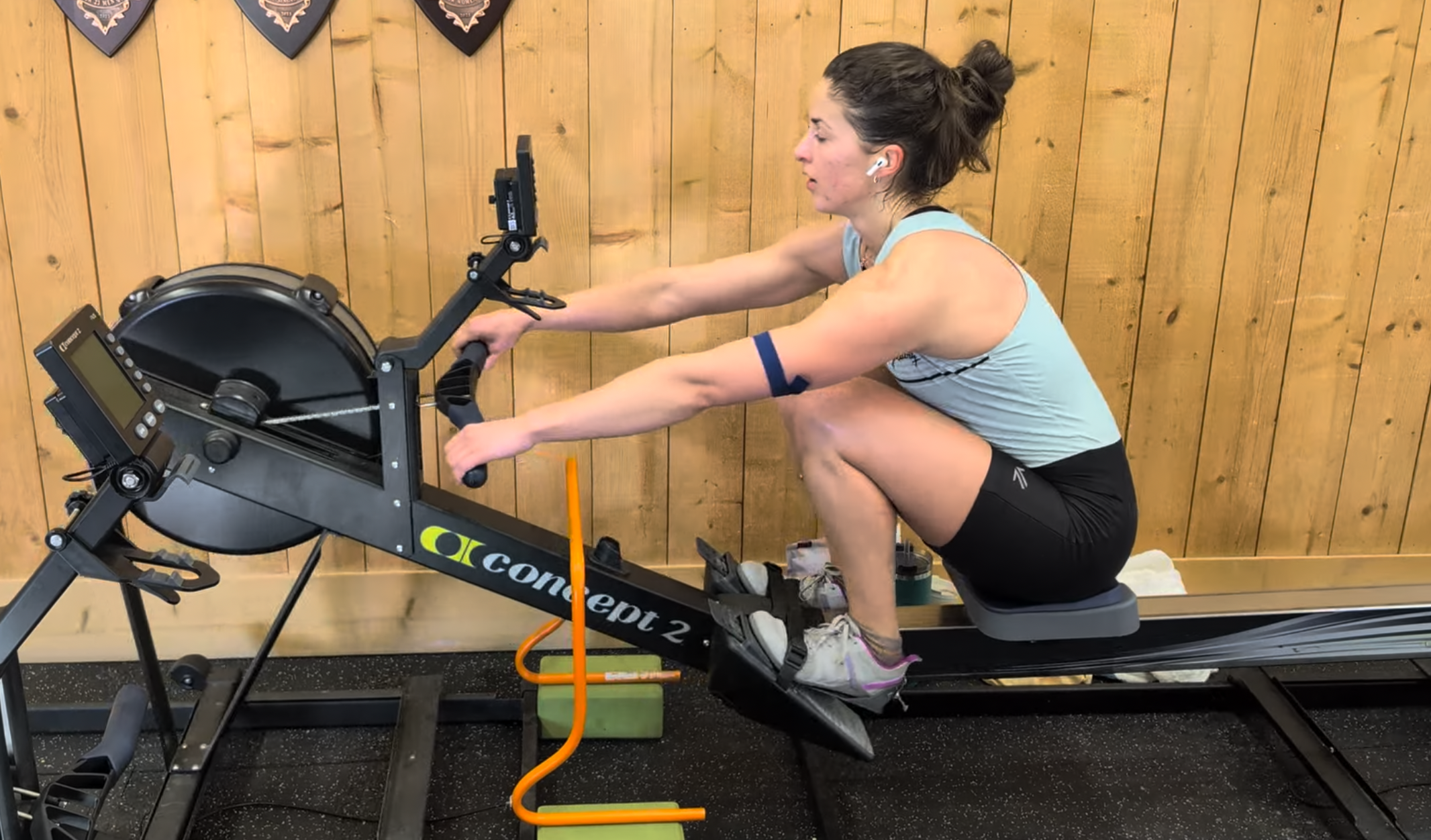
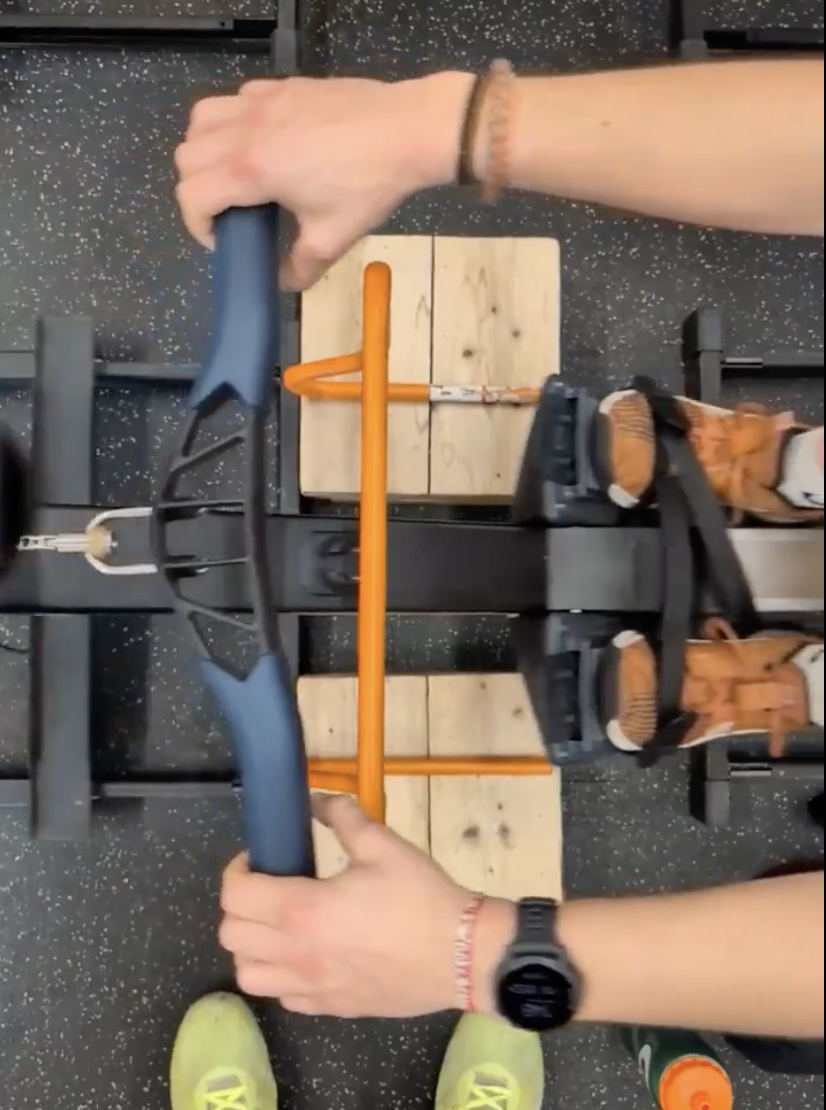
This came about when one of my rowers described trying to feel as if her "feet were being pushed under a table rather than dragging her hands across the top of the table." I thought that was a pretty articulate way of thinking about it and wondered, "Could I fit a table in there?" Not quite, but I could fit a small hurdle.
Watch in this video as the athlete works to get his feet further through the hurdle before his handle comes to and ultimately across the hurdle. This is a radical shift for this particular athlete.
We're a long way from the clickbait title of this tech tip, but I hope I've made my suggestion clear. This post is not about passing the time with winter training or entertaining yourself while gaining fitness. This is about keeping deliberate practice deliberate. This is about doing the hard work of keeping your central nervous system alert when your body is tired and your mind wants to be on standby. If you want to master something (or simply improve at it) and that something is very repetitive, then you must vary the stimuli in thoughtful ways to stay intentional and deliberate about understanding and improving that repetitive motion. I tell my GRP rowers that if they want to turn their brains off as they log the minutes they must for fitness, then don't do that on the erg! It's too close to the motion that you're trying to get really good at, and idle practice might just roll back the clock on your 10,000 hours (even if we only need 5,000).