
Tech Tip: In Pursuit of Length
by Erika Sloan, COC Sculling Associate Director and MIT Assistant Men’s Lightweight Coach
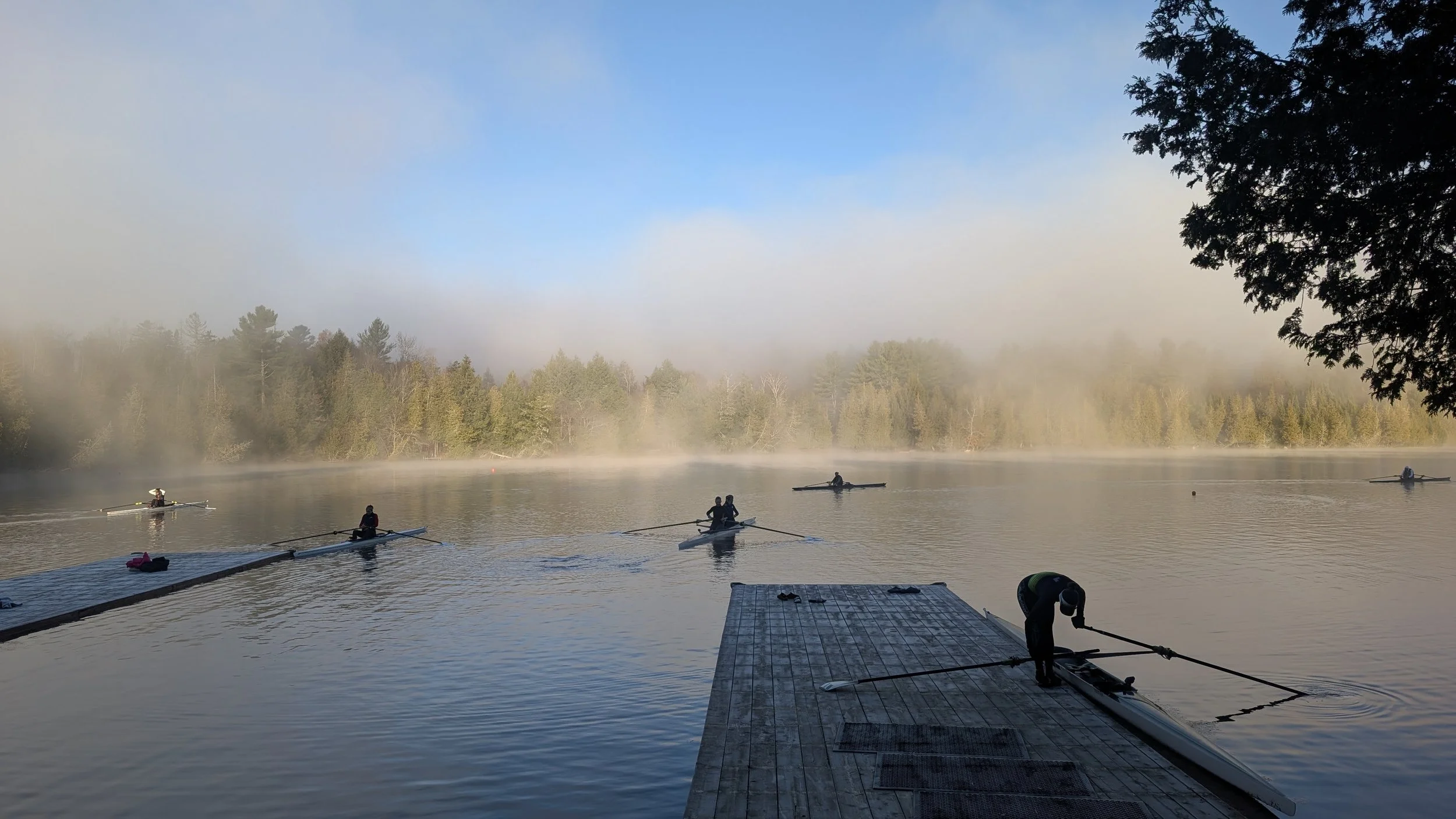
Like all rowers, though perhaps to an even greater degree given my stature, I have spent my entire rowing career in pursuit of length. At not quite 5’3’, I was told from day one that length is essential in this sport, and that my height would be a disadvantage. While these are certainly true, I’d argue that there’s a bit more nuance to the topic of length then we rowing coaches typically allow for.
First and foremost, while height and length are certainly correlated – a taller rower has the potential to row a longer arc – height does not guarantee that a rower will be effective for the full potential arc length of their stroke. At MIT, we make daily use of telemetry data to inform our coaching (in our case, the Peach PowerLine system), which gives us data on both the rowers’ overall length (degrees between the angles at which their oar changes direction at the catch and at the release) and their effective length (degrees within that arc where their watts are above a certain power threshold). We regularly see that there are plenty of taller rowers who row short (both in overall and effective length), and plenty of shorter rowers who can match the lengths of those taller than them.
In the case of the taller rowers who row shorter overall arcs, the cause is often limited mobility, especially a restricted range of motion when setting the hip angle. Common culprits for shorter effective length are typically technical deficiencies – often missing water at the front end, and washing out at the back end.
So, what can any rower, regardless of stature, do to increase their effective length? The first step is to determine the arc length that you’re able to move through while establishing and maintaining pressure on the face of the blade. One gift of rowing the single is the opportunity to find and row to your own effective length, without needing to match up angles with anyone else. There are two drills I like for this. The first is more front-end oriented, and a favorite at both Craftsbury and MIT. It has many names, but the gist is that you start with your blades squared in the water at the release, and back lightly through the water up to the catch, with good sequencing and posture through the core. Pause briefly there while keeping the blades buried, feeling the water gather around the blades, then initiate the drive. Repeat.
Why does this help? Moving through the entire stroke cycle with the blades buried at the same depth keeps everything horizontal and allows you to find a long, strong, stable catch position with your chest open and shins vertical; you’ll find that the water almost draws you out into it. By eliminating the complication of getting the blades to the water, it reduces the tendency to lunge or overreach into the catch, and ensures that you’ll initiate the drive with loading on the face of the blade. The nice, slow pacing of the recovery and the stability of having the blades in the water give you plenty of time and balance to check that you’ve reached full compression with good sequencing and without collapsing or shortening up due to instability. Memorize the feeling of your body position at the front end during this drill: while going back to blades out of the water on the recovery does reintroduce these complications, you’ll want to try to reach that same position every stroke – this is where you’ll find your optimal catch angle.
For the back end, I’m a big proponent of the classic feet-out drill. Since the oar is most effective before it reaches perpendicular, there’s no reason to try to get more length by leaning far back into the bow. You only have connection on the face of the blade if you have connection into the footboards, and the moment you lose that, you’re no longer moving the boat. Feet-out rowing teaches you exactly where that moment is, and trains you to release the blades just before you lose that connection. This makes it easier to get the blades out cleanly and set the boat up for good run on the recovery. Doing this well requires engagement through the core, hips, and glutes, as well as good connection and acceleration through the drive. If you find that you feel like you’re rowing short when you try this drill, you may need to work on these areas – or it may just be that you were rowing past your effective length before, and now you’ve found your optimal release angle. The tricky part is to maintain focus on this release timing even when you strap your feet back in.
If you find that, having established your effective arc length, you’re still rowing shorter than you’d like, there are steps that can be taken to yield a longer stroke. On the water, some things to consider include setting your upper body length early on the recovery, staying long and engaged through the core into the catch, minimizing inefficiencies, keeping your bladework direct and well-timed, and working on power application and acceleration through the drive. These are all key technical topics that would require their own articles to cover, so I won’t dive into them here.
There are also several off-the-water areas that are worth investing time into in the pursuit of length. All rowers can benefit from strength and mobility work to their time in the boat, but for short rowers, being strong – and particularly strong in long positions – can be hugely helpful. Core strength is essential and can’t be neglected. As I mentioned earlier, a lack of hip mobility can significantly reduce the degrees of arc available to you. Targeted strength, stretching, foam rolling, and yoga can help improve one’s ability to hinge effectively through the hips, thereby lengthening your stroke. I’d also encourage spending some time improving your ankle mobility. Good ankle dorsiflexion allows you to reach full compression without lifting your heels too much from the foot board, which in turn means that you can get your heels connected to the footboard sooner at the initiation of the drive, which will help with maximizing length. Spend some time in a deep squat and get comfortable there.
Rigging adjustments can help as well. Moving the footplate towards the stern will get you more catch angle. For those that struggle reaching full compression, dropping the heels can help. Shorter rowers can benefit from tightening the span and reducing the overall and inboard length of their oars to row through a longer arc.
And finally, to hammer home that rowing long is not solely the province of tall people, take a look at podium photos from 2017 W1x World Champion Jeannine Gmelin, the 2x of Nathan Cohen and Joseph Sullivan that won gold at the 2012 Olympics, 2024 Olympic W4x Champion Lauren Henry, and Bruno Cetraro Berriolo, who made the A Final in the heavyweight men’s 1x at the 2025 World Championships at 5’7”. There’s plenty of speed to be found by rowers of all statures, if you’re willing to put in the work.