
Tech Tip: The Magic of Knee Break
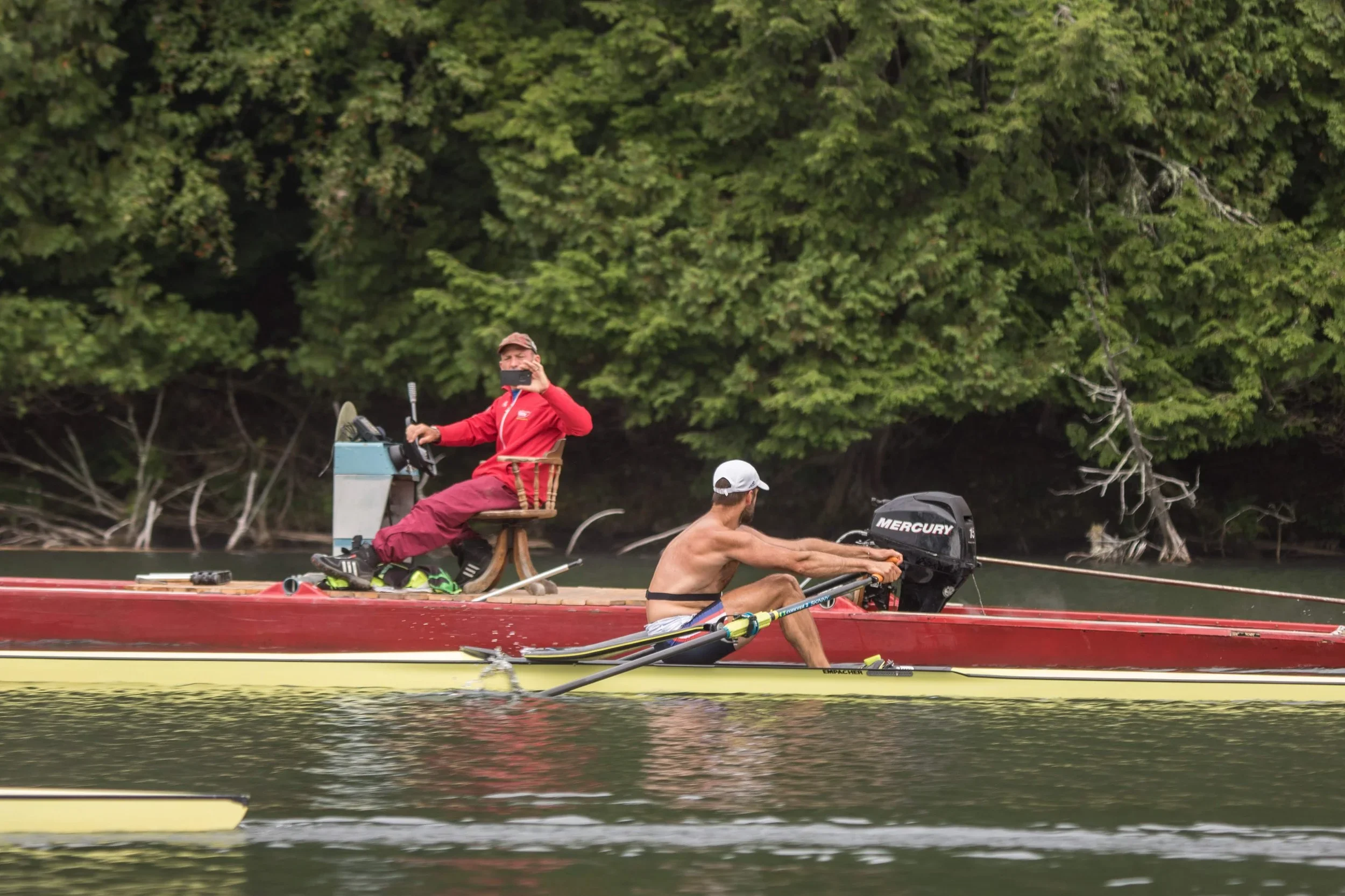
Coach Troy Howell videoing John Graves on Big Hosmer.
Directness is something I'm always working on as a coach or teacher of rowing. Sometimes, I steer clear of the repetitive, mainstay cues for fear of being overly simplistic, only to hear later on how amazingly effective "shallow blades" or "early roll up" was for a crew. What I lack in pointed, staccato remarks, I try to make up for in a deeper inquiry as to why something can't be easily learned and how it potentially can be. Lately, I've had two proprioceptive revelations come to light around the release of the knees. Whether it's my aforementioned verbosity or the fact that I'm a new, first-time father, I'd like everyone to sit back, relax, and prepare for story time with this tech tip.
It begins in a far-off land when I was still an active sculler striving for the Olympics. I remember watching my teammate John Graves push the limits of his body angle. By this, I mean he would keep his body at an acute angle from the hips for the majority of the leg drive. The image of him doing it so well helped me sculpt my own image in my head. When someone finally remarked about a perceivable change in my stroke, I remember locking in a new sensation around my torso's position on the slide. I told myself that my chest felt "down but up." I thought this was ingenious. It perfectly described the intentional tension I felt within my body like a timber frame structure twisting and locking into place. However, when I would share that tidbit with philanthropic pride, people would look back at me like "thanks for nothing."
The feeling was so strong for me, though, that I never let go of it. Then, during a rare row of my coaching career, it came to me during a slow-motion execution of legs only. With my body hinged sharply at the hips, the full slide ahead of me, and my puddle-building ego safely put on hold, I felt myself smoothly but slowly feed the slide under my seat with the stillest of torsos. Then, I changed directions without urgency, all the while thinking about how I could somehow make "down but up" more relatable to my rowers. After a few slow-motion, legs-only attempts, I moved to a somewhat tentative legs-only rowing-in-place drill where the blades would stay buried as I slowly rotated the oarlocks with only the movement of my legs. There it was!
What I noticed during these tai-chi-paced strokes was that I gave myself a different cue depending on whether my knees were rising or falling. In other words, when on the recovery and using the slide to deliver me to the blade entry, I need to remind myself to keep the chest up into the front end. Conversely, after the blade placement, I had to cue myself to keep my chest down as the knees began their descent with the start of the drive. When you think about it, these cues address common technical challenges. Keeping your chest up into the front end prevents "lunging at the catch." Meanwhile, isolating your leg drive at the start of the drive is most frequently challenged by the unconscious opening of the back. In order to keep my torso in the same position, I had to give it completely different directives depending on whether or not the knees were rising or falling.
This recently came up again with an athlete as we knew "chest up" into the front end helped exchange skying blades for direct entries. However, it became clear that cueing for "chest up" was only on the table as an actionable call if the body was prepared before the knees were released. To me, this reiterates the difficulty of the proprioceptive challenge to keep your body still and supported while continuously traveling backwards at different rates of speed and coordination in your body's movements.
This dovetailed into a new thought today. Due to the full extension of the legs in the second half of our stroke, people often refer to releasing the knees when you engage the slide on the recovery. Assuming a proper preparation of the arms and the hips (or torso), what else do you release when you release the knees? Do you release your seat? Or do you release your feet? The most common thought is releasing your seat. After all, it has wheels and can roll. In contrast, your feet are screwed into place! This line of thinking is also a derivative of static erging in which you deliver your body to the front of the machine by way of sliding the seat towards the machine.
But what if you release your feet? What if with the releasing of your knees, you work harder to visualize your feet coming under you rather than your seat driving to your foot stretcher? Notice, earlier I referred to feeding my slide underneath me. When we take the recovery and feel our body mechanically coil up or move momentum to the stern of the boat, the boat doesn't stop doing what it was doing when we began that process. The whole time it is continuing to move in the direction of the bowball. Sure, sometimes we do adverse enough actions with the transition between recovery and drive that we "check" the boat speed, but never completely check it down to a stop in this process. The more actively you can engage with the idea of releasing your feet when you release your knees, the more you will encourage the boat to come underneath you and carry more speedily on its way to the bow. Think of this as a proprioceptive manner of the glass being half full or half empty. Let's go for the half full and cultivate run.
If you want to lead some inquiry into these areas, I would recommend the drills of the first story: tai-chi legs-only along with legs-only rowing-in-place. For looking into the second point, I would first practice very deliberate preparation with a bodies-over pause and a quarter-slide-pause. Then, I would explore some reverse ratio to feel what happens when you really draw the boat under you. Make sure to try some legs-only-reverse-ratio. After all that, just row with a micro pause once your arms and body are prepped. In that pause, ask yourself what you want to release when you release your knees.