
Tech Tip: hold the hips rather than the feet
by GRP Row coach S. Hap Whelpley
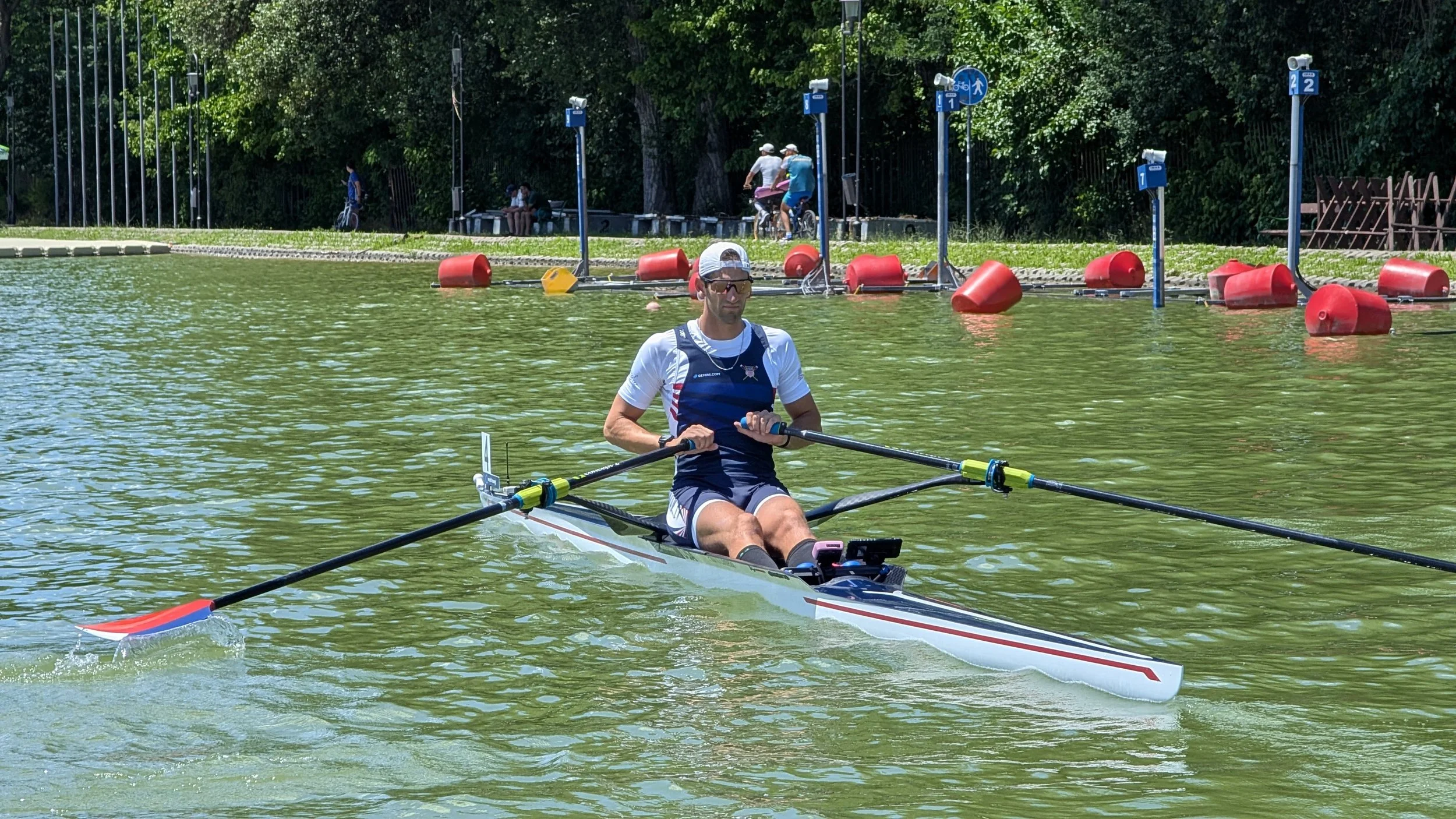
With the fourth foot stretcher being broken, I can't help but revisit a topic in a slightly new light. If you browse our tech archives, you'll find posts from myself and others that reference your feet:
And my brain is right back at it again! We have had several foot stretchers broken at the base where the footboard comes down on either side of the main bottom brace. As if we were doing a scientific study, this has happened in multiple different hulls by different manufacturers. This can only be done with a gratuitous amount of heel pressure. In my mind, more pressure is going into the bottom of these carbon fiber foot plates than is coming out of the boats' movement. The other common denominator I have observed in these footboard scenarios is an athlete with a bent knee at the release position.
In the first half of the stroke, I believe you need to build something off which the second half of your stroke is built. This is not just in a sense of force generation and propulsion, but also biomechanically in the body. How you push your hips to bow must then inform how you sit on your hips in bow.
I have regularly encountered athletes that do not fully extend their knees. They don't complete the jump that Ric Ricci talks about in his tech tip above. Often, I think this comes from a misunderstanding of how to stay connected to the footboard in the second half of the stroke. Some athletes have heard, "stay connected to the footboard" and intuitively tried to do so by contorting their feet with tension within the shoe. Others have been told to plant their heel and keep it planted. As a result, both these athletes wind up valuing a foot position over a hip position. They wind up prioritizing a pressure in the shoe over a push of the seat and the hips when really the foot pressure should be a derivative of the hip drive.
I think many factors go into what part of your foot stays connected to the footboard. Things like rigging, mobility, and even shoe design may affect how your foot remains in contact with the footboard. The key is that some part of your foot stays in contact with the footboard through the back end of the stroke.
Aside from observing things that didn't look like natural movements to me, this thought of building a bodily position for the second half of the drive through the foot stretcher in the first half of the drive stems from a few productive places:
I always say you need to generate swing from your hips, not the seat. Many athletes suspend the first half of the drive only to land on the seat mid drive, root down through the seat, and utilize it as a fulcrum to lever their torso to bow. In contrast to this, you need to think more of the full hip extension that occurs during a kettlebell swing where you don't have a seat on which to anchor. You use your hip extension combined with a stable core and pelvic floor to swing a weight to head height.
Katy Ruderman, who is coaching with me this summer, mentioned how she likes to think of establishing a platform for your body through the leg drive. Once you've established that platform, you want to maintain it through the swing. The quality of your leg drive's completion will help dictate how strong of a foundation you have for your swing as well. Imagine building a home. You start by making a foundation. When that's done and you start your framing, you wouldn't want to take a sledgehammer to the foundation you had just built!
Keiran Clark, who is a British coach and rowing influencer, had a post that referenced trying to create the greatest distance between the feet and the seat and then holding that distance through the remainder of the stroke. That's the key. He called it "spreading the feet and the seat as far as possible." Once that maximal distance is established, it must never be reduced if the blade is still in the water with the handle traveling to the bow.
I would suggest taking a few of the most seemingly simple building blocks of our drillwork and putting a magnifying glass to them. Consider tying a static string or possibly something with some elastic resistance from the front axle of your seat to a point in the middle of the footstretcher. Make sure that the length of the string or band is perfectly measured so that it is taught when your knees are fully extended and your hips are pushed as far away from the stretcher as possible. Once this is established and fixed, go for a row and spend some time doing:
arms only
back & arms (or swing and arms)
quarter slide
These beginning stations of the "pick drill" are very commonly done without a good foundation in the hips. See if when you do arms only, you can keep constant tension on that string or band. Add the back. Can you still do it? It is likely harder. Now, move out to quarter slide, and perhaps the idea gets easier again since your movement begins with a push of the hips. At all three stations, you should be able to keep constant tension on the string once the leg drive is completed. It doesn't matter where your foot is feeling the foot stretcher as you do this. However, I guarantee your feet are feeling the footstretcher somewhere if you both 1) keep tension on the string and 2) use whatever length stroke you have to move the boat while you do it.